

The Lit Sponge is written on the lands of the Wurundjeri people and acknowledges them as the traditional owners of this land, which was never ceded. I would also like to pay my respects to their Elders, past and present.
My generation walked to school in the last few years of the Safety House Program. It had been in effect in Victoria since the 80s as a way to combat child abduction—as though children didn’t have more to fear behind the closed doors of their homes and churches. But a broader fear of children snatched from bus stops and shopping centres was easier to talk about, a fear of children vanishing, so we drove neon yellow signs into the turf in front of unfamiliar houses with the faith that our organised community could ward off the unknown.
It made sense to be afraid of disappearing, we always have been.
The trope of white people vanishing into the Australian landscape has filled our country’s collective literature since the 1790s. Even in a built-up urban environment, far from picnics at Hanging Rock, there remains an ever-present anxiety. Ever since we arrived as colonisers and convicts, we have never fully trusted this landscape to care for us. Maybe it’s because we know deep down that we never really subdued it.
These thoughts were close to my mind when I first read Shaun Prescott’s debut novel The Town, which delves deep into this on-going battle in the White Australian psyche.
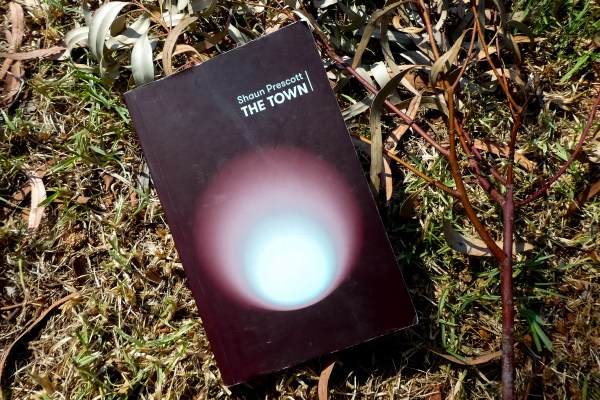
Its retro, matte cover and colour palette has the feel of a cult classic at the back of a second hand store, but its content is modern Australian myth making.
The town that Prescott describes is deeply familiar. Reading it, I felt I knew its streets as well as my childhood beat in northern Victoria—an amalgamation of every small town I’ve bought fish and chips in or stopped by on a longer journey through the heartland.
It is also the fullest embodiment I’ve seen of our cultural fear of disappearing.
The Town is a book about annihilation: not the explosive, memorable kind, but […] the annihilation that comes from fading away.
Alex Tighe, Neighbourhood
Alex Tighe, author of Neighbourhood says “The Town is a book about annihilation: not the explosive, memorable kind, but […] the annihilation that comes from fading away.” The citizens of the town have long since stopped trying to meaningfully inhabit the landscape around them, and their repetitive motions of daily life no longer fill this space. As pockets of pavement outside the RSL disappear and great translucent portals fill the Main Street, Prescott reminds us that the town has never really belonged there, and that its citizens’ failing community is not enough to hold it together.
A large-scale vanishing is in process.
While Prescott only subtly engages with colonial narratives, the town, set in the Central West region of New South Wales, is undeniably white. We meet Rob who is ‘enthusiastic about sport’ and The Town’s unnamed protagonist drinks longnecks in the street while avoiding a bashing in the local pub from town bully Steve Sanders. Local history has no importance in local consciousness; more important is an unflinching belief that belonging can only come from a life spent in one community. Even a community whose identity has stagnated. Even a community that is beginning to disappear.
It was this atmosphere that immediately drew me to this book. I was excited to see the magical realism that I’d enjoyed so much in Murakami’s Tokyo reborn in an Australian setting. But if I expected something purely Murakami-esque, I far underrated what The Town had to offer. Streets flanked by Woolworths and Michel’s Patisserie, the Golden Arches and the BP on the road heading out, made the town feel mundane. And yet the atmosphere Prescott builds is subtly horrific. There’s a dread among the townspeople that they are unable to name or act upon, which manifests in moments of extreme violence. As the town vanishes, disappearing people are as accepted and unremarked upon as the boarded-over gaps in the pavement. In this, The Town becomes somewhat of an apocalyptic novel for White Australia’s colonial identity.
As Steve Sanders says, ‘This is how things are going to be from now on. This is how they’re going to stay. History can end, you know. It doesn’t have to keep going […]’
*
Prescott’s writing flows in much the same way as the mysterious piano music Ciara plays on the town radio station, lulling readers into a sense of deeply repetitive—if not slightly unhinged—normality, a small town going through motions that haven’t held meaning for a long time. He also chooses to avoid regular chapters, instead splitting the book into three distinct sections: The Town, The Disappearing Town and The Disappointing City. Without these breaks, this novel might struggle to draw readers through its prose. Instead the feel it has is of one unending thought, making for a compulsive reading experience.
However, while the prose fits with the slowly building atmosphere of inertia and ambivalence it also makes this book difficult to resolve. In fact, there is a deliberate lack of resolution at the end of The Town that Prescott rounds off with a broader fatalistic commentary: that white Australians do not belong anywhere. The people of the city and of the country are ‘united only by the truth that they are there, connected by the dirt they claim to own.’ And for all of our literature’s hyper vigilance and fear, it feels apt that in Prescott’s moment of vanishing we feel nothing but a deep sense of inevitability.
I do have a couple of gripes with The Town, but they’re largely mitigated by its many strengths. The style of Prescott’s writing is an acquired taste that sits more comfortably as you read further, but its uncompromising slow beat might take a few chapters to adjust to for readers used to fast-paced commercial reading experiences. More frustratingly though, the blurb of The Town bills this story as a race against time, where the townsfolk must find ‘the truth about their collective past’ before the town disappears, a drive that is deliberately missing from its writing style and plot. The Town is hardly the first book to use a misleading punchy sentence to sell more copies, but this assertion is completely discordant with the book’s tone and central question.
This is my first foray into Brow Books’ titles from the last year and The Town has only made me more eager to read more from this publisher and author. It is an experiment in discussing the un-discussable: a fear that we have no place here—something that, even a year on from The Town’s publication, feels increasingly important.
The white Australian community continues to struggle to come to terms with the fragility of our belonging in this colonised country. But in starting to think more about it and critique the dominant myths at the heart of our culture, The Town is a good place to start.
Some final details:
- If you’d like to read more about Australian literature’s trope of white people disappearing into the landscape, Elspeth Tilley’s book White Vanishing is a good starting point.
- Ciara’s hoarded cassette tapes are a bit like T.S. Elliot’s ‘These fragments I have shored against our ruins’, and while that’s not super relevant, it’s a cool idea.
 The Lit Sponge